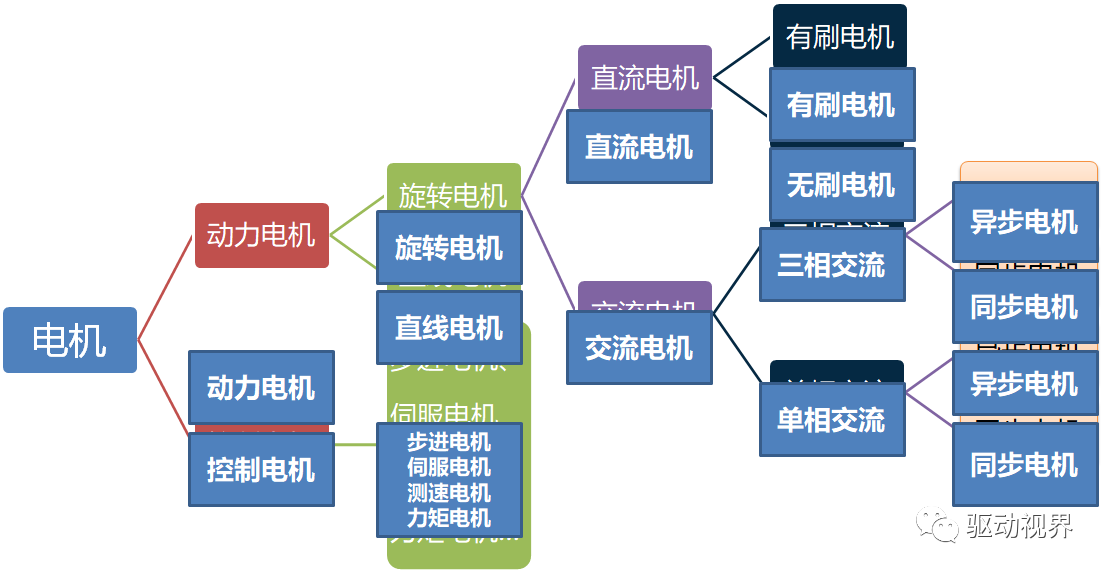
Understand the Basic Types of Motors in One Chart
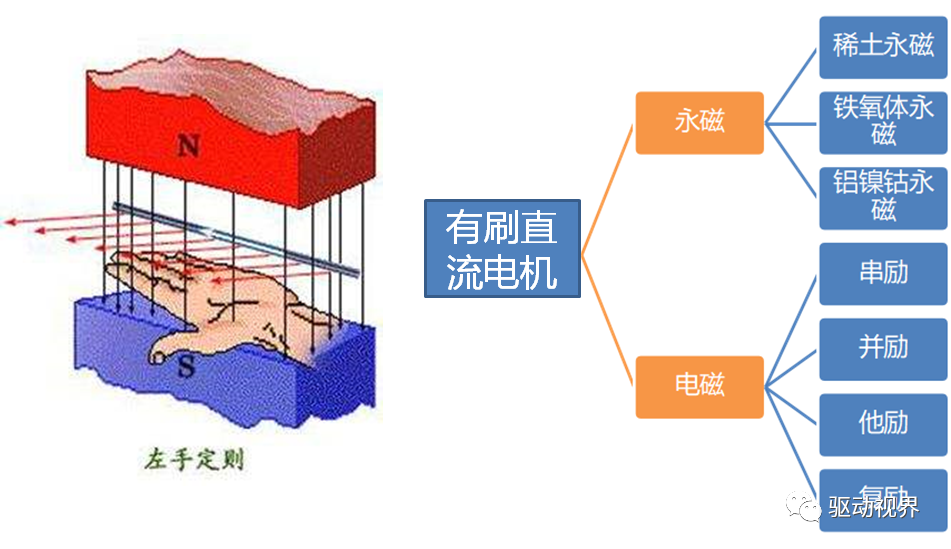
DC Motor — Brushed Motor
Anyone who has studied middle school physics, whether a top student or a struggling one, knows that we've practically worn out our left hands learning about the force on a current-carrying conductor in a magnetic field.
This is exactly the working principle of a DC motor.All motors consist of a stator and a rotor. For the rotor of a DC motor to rotate continuously, it is nec-
essary to constantly reverse the current direction; otherwise, the rotor can only turn half a circle, much like the pedals of a bicycle.That's why a DC motor needs a commutator.In a broad
sense, DC motors include brushed and brushless types.A brushed motor is also known as a DC motor or carbon brush motor, and the commonly referred to DC motor specifically means a
brushed DC motor. It adopts mechanical commutation, with the external magnetic poles fixed and the internal coil (armature) rotating. The commutator rotates together with the rotor coil, while the car-
bon brushes and magnets remain stationary. Thus, the commutator rubs against the carbon brushes to switch the current direction. (Video Link).
Disadvantages of Brushed Motors:
1. Sparking from mechanical commutation causes friction between the commutator and carbon brushes, electromagnetic interference, high noise and a short service life.
2. Poor reliability, frequent failures and the need for regular maintenance.
3. The presence of the commutator limits the rotor inertia and maximum speed, affecting dynamic performance.
Despite these many disadvantages, it is still widely used because of its high torque, simple structure with easy maintenance (i.e., carbon brush replacement), and low cost.